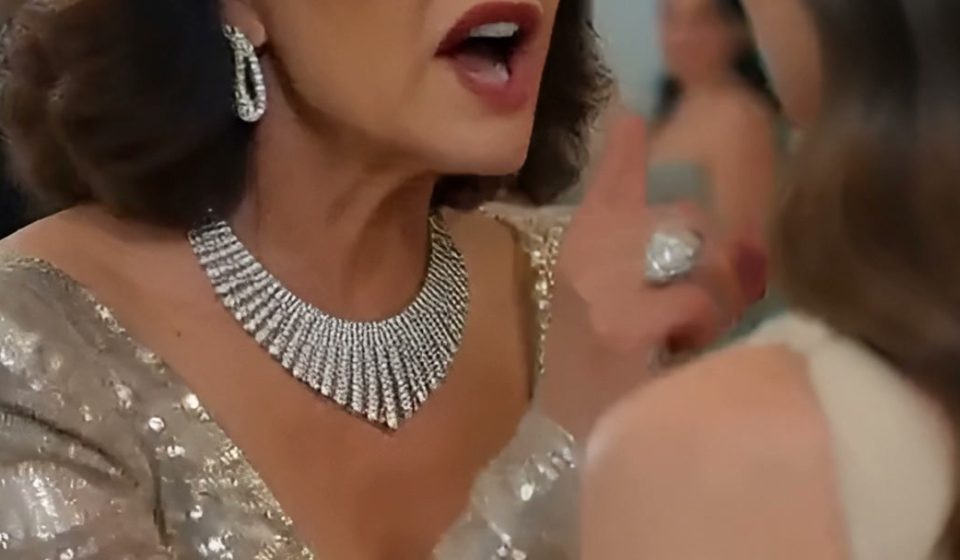

Billionaire Roman Voss caught a mother’s wrist as she shoved her own daughter out of the family photo… But when the girl looked up through her tears and whispered, “You’re the boy from the hospital,” Roman’s champagne glass slipped from his hand.
The engagement gala at the Ashford mansion had been running for two hours, and Roman Voss had been bored for all of them.
He stood near the back of the marble hall, a glass of champagne he hadn’t touched warm in his hand, watching the crystal chandeliers throw light across three hundred people who all wanted something from him. He had given none of them the satisfaction of even a full sentence.
“Mr. Voss.” His assistant appeared at his elbow. “The Ashford family is lining up for the photographer. Mrs. Ashford has been asking—”
“I see it,” Roman said quietly.
He did see it. He saw the whole thing.
The photographer, a nervous young man with too much equipment, was herding the Ashford family into a crescent near the grand staircase. Senator Ashford in the center. His son, the groom, and the beautiful fiancée beside him. The older daughter, in emerald silk, sliding into place like she had rehearsed it. And then, at the edge of the group, a girl of maybe seventeen in a plain cream dress — not silk, not satin, just plain cream cotton — who stepped tentatively forward to join them.
She had dark hair pulled back simply. She was holding her own hands together in front of her, the way people do when they are trying to take up as little space as possible.
Roman watched Patricia Ashford, the mother, in a pewter ballgown that cost more than most people’s cars, turn and see the girl step forward.
What happened next took four seconds.
Patricia closed the distance, gripped the girl’s upper arm, and walked her firmly backward — not toward the family, toward the service corridor door half-hidden behind a floral arrangement. She said something low and close to the girl’s ear, released her arm, and turned back to the photographer with a wide smile, smoothing her gown.
The girl stood in the shadow of the corridor entrance. Her chin was up. She was clearly fighting very hard not to cry in public, and she was losing.
The guests nearest to it had seen. Roman could tell by the way they suddenly found their champagne glasses very interesting.
He set his own glass on a passing tray and walked across the marble floor.
He didn’t hurry. He didn’t need to. The crowd parted the way crowds always parted for Roman Voss, by instinct, by the particular quality of his stillness when he moved through a room. He reached Patricia Ashford just as she was positioning herself beside her husband for the photo.
His hand closed around her wrist — gently, but completely.
“Mrs. Ashford.” His voice was conversational. Every person within eight feet went rigid. “Where has your family been hiding her?”
Patricia turned. For the first time all evening, the performance on her face slipped. “I beg your pardon?”
“The young woman you just removed from the photograph.” Roman did not raise his voice. He did not need to. The room had gone so quiet that the chandeliers seemed to hum. “She’s family, I assume, given the resemblance. I’d like to meet her.”
“Claire is — she’s not really part of the—” Patricia stopped. She looked at Roman’s hand on her wrist. She looked at his face. “She’s my daughter from my first marriage. She’s more comfortable helping in the—”
“Bring her over,” Roman said.
It was not a request. Patricia knew it was not a request. Everyone in the room knew it was not a request.
Someone near the service corridor door moved, and a moment later Claire walked back across the marble floor, her arms wrapped around herself, her eyes red at the corners. She stopped in front of Roman and looked up at him the way people look at things they cannot quite account for.
“Claire,” Patricia said tightly, “this is Roman Voss. Mr. Voss, my daughter.”
“I know who he is,” Claire said. Her voice was steadier than Roman expected.
“Then you have the advantage of me.” Roman let go of Patricia’s wrist. He turned fully toward Claire, which meant he turned his back on Patricia and the Senator and the photographer and three hundred guests, none of whom existed to him in this moment. “You look like you want to say something.”
Claire looked at him for a long moment. A tear broke free and ran down her cheek and she didn’t brush it away.
“You’re the boy from the hospital,” she said.
Roman went very still.
The room continued to exist around him — the clink of glass, the rustle of silk, the nervous cough of the photographer — but it seemed to be happening at a great distance.
“Say that again,” he said quietly.
“St. Catherine’s Children’s Hospital.” Claire’s voice was careful now, like she was handling something fragile. “Twelve years ago. I was in the long-term ward. Leukemia. You were — you weren’t a patient. You were visiting someone. You came into the ward common room at two in the morning because you couldn’t sleep, and I was in there because I couldn’t sleep either, and you sat with me for three hours and you never once told me I was going to be fine.”
Roman said nothing.
“Everyone else always said I was going to be fine,” Claire said. “You just sat there and played cards with me and told me about this project you were going to build someday, a diagnostics company, because you were angry that kids had to wait six weeks for test results.” Her voice broke slightly on the last word. “I was twelve. I thought I’d made you up. I thought you were a fever dream.”
Roman stared at her.
He had been eighteen. His mother had been in the hospital — a different ward, a different floor, a different kind of dying. He had walked the hallways at two in the morning for three nights running because the alternative was sitting in a chair watching monitors, and he had found a girl in a yellow hospital gown playing solitaire with a worn deck of cards and losing badly.
He remembered her.
He had never forgotten her, actually. He had thought about her — the particular quality of her stubbornness, the way she refused to let him let her win — approximately once a month for twelve years, in the vague, unresolved way you think about something unfinished.
“You beat me at gin rummy four times,” he said.
Claire laughed. It came out broken and wet and completely real. “Five.”
“You cheated on the last one.”
“I was on a lot of medication.” She wiped her face with the back of her hand. “What diagnostics company?”
“Voss Diagnostics. We brought standard results turnaround down to seventy-two hours in twenty-three states.” He said it matter-of-factly, the way he said most things. “I was angry for a long time.”
“I know,” Claire said. “You told me.”
Behind them, someone — Senator Ashford, Roman thought, though he didn’t turn to check — cleared his throat. The photographer had lowered his camera. Patricia Ashford was standing very still with the particular stillness of a woman watching a situation leave her control entirely and being unable to stop it.
Roman looked at Claire — at the plain cream dress, at the red around her eyes, at the complete absence of any performance on her face — and then he turned and looked at Patricia.
“Mrs. Ashford,” he said pleasantly, “I’d like your daughter in the photograph.”
“Mr. Voss, I don’t think you understand the family dynamics—”
“I understand them perfectly.” His voice did not change. It never changed. “I’d like her in the photograph. I’ll be in it as well, if the family doesn’t object. I suspect the family won’t object.”
The Senator did not object. The groom did not object. The fiancée, who had been watching the entire exchange with wide, fascinated eyes, shook her head quickly to indicate she absolutely did not object.
Patricia Ashford looked at Roman Voss — at his stillness, at his money, at the twelve years of particular, quiet, directional anger that had built a diagnostics company because a girl in a hospital couldn’t get her test results fast enough — and she stepped aside.
Claire looked at Roman. “You don’t have to do that.”
“I know I don’t.” He offered her his arm, the way his mother had taught him thirty years ago. “Come take a photograph with your family.”
She took his arm. They walked to the crescent together. The photographer, with the instincts of someone who understood when he was watching a significant moment, arranged everyone and then stepped back and took the shot.
In it, Roman stood at the edge of the group, and Claire stood beside him, and she was looking up at him and he was looking down at her, and neither of them was looking at the camera.
It ran in three society pages the following week.
Patricia Ashford spent the weeks after the gala discovering that several significant charitable committees she chaired had quietly been restructured, and that the lead donor — anonymous — had attached a single condition: a policy of full family inclusion in all public events, no exceptions, no discretion left to individual families.
She never proved it was Roman.
She knew it was Roman.
Roman called Claire six days after the gala. He left a message, because she didn’t pick up, which he found privately amusing. “This is the boy from the hospital,” he said. “I’ve been thinking. I’d like to start a pediatric wing at St. Catherine’s. I could use someone who knows what that ward actually needs from the inside. If you’re interested.”
She called back in four minutes.
They met for coffee the following Tuesday. He brought a deck of cards, because he intended to win back at least one of those five games, and she arrived with a notebook full of ideas about what a children’s long-term ward actually required, which she had apparently been drafting in the forty-eight hours since his call.
He read every page.
Six months later, the planning committee for the Claire Ashford Pediatric Wing at St. Catherine’s Children’s Hospital held its first meeting. Claire chaired it. Roman sat at the other end of the table and did not let her win a single procedural vote that she hadn’t earned.
She won most of them.
He had known, at eighteen, sitting in a hospital common room at two in the morning, playing cards with a girl who refused to lose gracefully, that there was something in her that was going to matter. He had just not known it would take twelve years, a marble hallway, and a mother’s cruelty in front of three hundred witnesses to find it again.
He didn’t believe in fever dreams.
He believed in unfinished things, and in the particular satisfaction of finishing them.
The card he kept in his desk drawer was from a worn deck, bent at one corner, with a small penciled tally mark on the back that read 5–0, Claire.
He had always intended to return it.
He gave it back to her at the groundbreaking ceremony for the pediatric wing, in front of the cameras and the board members and the St. Catherine’s staff, slipping it into her hand when they shook on the final agreement.
She looked at it. She looked at him.
“Interest,” he said.
She put it in her pocket. “The interest would be six games.”
“Four,” he said.
“I was on a lot of medication.”
“You keep saying that.”
She laughed — the same broken, real laugh from the marble hallway — and this time neither of them was crying when she did it.