
CEO Roman Hale watched a young cleaning girl in a grey uniform polishing a showroom car… But when she opened her fist and he saw the key, he went completely still.
The Whitmore Motors showroom was the kind of place where the floors cost more than most people’s houses. Roman Hale stood near the back with two clients, pretending to listen, while golden afternoon light turned every chrome bumper into a mirror.
He noticed her because she was careful.
The young woman — maybe twenty, dark braid, grey uniform two sizes too big — moved a chamois cloth across the hood of a pearl-white Bentley in slow, deliberate circles. Not sloppy. Not distracted. Like she was afraid of leaving a mark.
“Hey.” The voice cracked across the room like a whip.
Derek Moss, the floor manager, was already moving. Forty-five, red-faced, the kind of man who kept his aggression polished to a shine along with the cars.
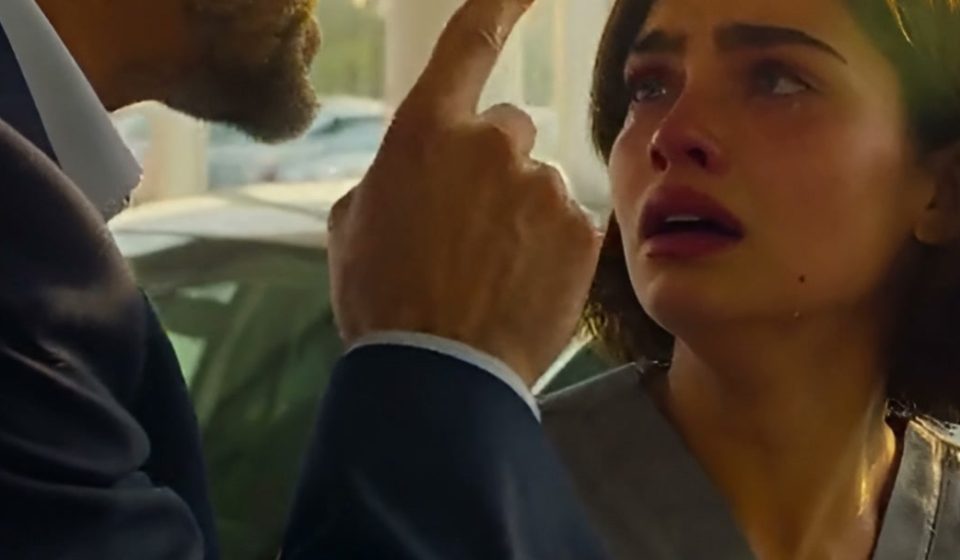
“That vehicle is reserved. You don’t touch reserved vehicles.” He snatched the wet cloth from her cart and threw it hard across her face. The wet slap of it echoed off the glass walls.
Every customer in the room went quiet.
He grabbed her by the shoulder, fingers digging in, already turning to push her toward the service door.
Roman was moving before he’d decided to.
His hand closed around Derek’s wrist from the side — one motion, no warning, no theatrics. He simply stopped it. Derek’s grip on her shoulder broke.
“Let go,” Roman said. Two words. Quiet.
Derek blinked at him. “Mr. Hale, she touched a reserved—”
“I heard you the first time.” Roman didn’t raise his voice. He didn’t need to. “Step back.”
Derek stepped back.
Roman turned to the young woman. She was pressing the back of her hand against her cheek where the cloth had hit, eyes wet, chin up — she was trying very hard not to cry in front of a showroom full of strangers, and she was almost succeeding.
“Are you hurt?” he asked.
“No,” she said. Then: “Yes. I mean — my face is fine.” She exhaled. “I’m sorry about the car. I was just — the hood had a smear, and I thought—”
“You did the right thing.” He handed her a folded handkerchief from his jacket pocket. “What’s your name?”
“Mara.” She took the handkerchief but didn’t use it. “Mara Calloway.”
He nodded. “Roman Hale. I own this building.” He said it not to impress her but because he wanted her to know Derek Moss would not be a problem again. “Do you want to sit down?”
“I need to show you something first.” Her voice was steadier now, which surprised him.
She opened her fist.
On her palm lay a small steel key on a worn leather tag, rubbed smooth at the edges like it had lived in a pocket for years. The tag was hand-stamped. Three letters: W-H-M.
Whitmore Motors.
Roman went very still.
“Where did you get that?” he said.
“My father.” She watched his face carefully. “He worked here. Night security, about twelve years ago, before the ownership changed hands. He said the night manager gave him this key and told him to keep it safe.” Her jaw tightened. “He went to work one night and never came home. The police said he just left. Left us.” She pressed her lips together. “But my father didn’t leave. He wouldn’t.”
Roman took the key from her palm slowly, like it might break.
The leather tag. The hand-stamp. He recognized it because he had signed the requisition order himself, twelve years ago, when he was twenty-six and newly promoted to operations director — before the Whitmore family sold and he took over. The night manager’s key set. Three were issued. Two were returned.
One was listed as lost.
“What was his name?” Roman’s voice was different now. Quiet in a different way.
“Daniel Calloway.” She watched him. “You knew him.”
It wasn’t a question.
Roman closed his fingers around the key. His clients were pretending to look at brochures. Derek Moss had vanished. The showroom was completely silent except for the low hum of the ventilation system and the sound of afternoon traffic outside.
“I knew him,” Roman said.
Daniel Calloway had worked the night rotation during a period when Roman had been quietly auditing inventory discrepancies — cash transactions that never appeared in the books. Three months into that audit, Daniel had come to him privately with a photograph. Two men in the loading bay at 2 a.m. A transaction Roman recognized instantly and which could have dismantled three careers above his own.
Roman had told Daniel to keep the photograph. Keep quiet. He’d handle it.
Three weeks later, Daniel Calloway didn’t show up for his shift. Roman had assumed — had been told — that Daniel had taken a settlement and relocated. He’d been twenty-six. He’d believed it because believing it was easier.
He had never checked.
“Mr. Hale,” Mara said. Her voice was very careful. “Do you know what happened to him?”
Roman looked at her. The braid. The grey uniform. The chin still lifted even though her eyes were still wet. He thought about what it cost a person to walk into a room where they’d been humiliated and hold out a key and ask a question they were terrified to have answered.
“I know where to start looking,” he said. “And I should have started twelve years ago.”
He handed her back the handkerchief. This time she used it.
“I want you off the cleaning rotation today,” he said. “Not because of what happened — because I need someone in my records office who isn’t afraid to wipe away a smear when she sees one.” He paused. “If you want it.”
Mara looked at him for a long moment. “Will you tell me the truth about my father? Whatever you find?”
“Yes,” he said. “All of it.”
She nodded once. “Then yes.”
Roman walked directly to Derek Moss’s office, set the key on his desk, and told him to clean out his drawer. Then he called the one private investigator he trusted — a former federal agent named Liz Chen who owed him nothing and answered to no one — and read her Daniel Calloway’s name over the phone.
Liz called back in four days.
Daniel Calloway had not left. He had been removed. The two men in the loading bay photograph were still in the industry — one of them a regional director at a competitor. What had been done to Daniel was provable. The photograph still existed, archived on a server backup Roman’s IT team located in eleven hours once they knew what to look for.
Roman sat across from Mara in his office and told her everything. He did not soften it. He did not skip the part where he had been twenty-six and chosen to believe a convenient lie.
She was quiet for a long time after he finished.
“He was protecting us,” she said finally. “He thought if he handed the photograph over and stayed quiet, we’d be safe.”
“Yes,” Roman said.
“And they got rid of him anyway.”
“Yes.”
Another silence. Then: “I want them to answer for it.”
“They will,” Roman said. “The investigator’s report goes to the DA’s office tomorrow morning. Both names. The photograph. The transaction records.” He looked at her directly. “I’ll be in the room when it happens, if you want me there.”
“I do,” she said.
The regional director resigned before the arrest. It didn’t help him. The charges came anyway — conspiracy, suppression of a witness, offenses that carried weight even twelve years on. The second man took a plea.
Roman attended every hearing.
He also quietly funded the search for what had happened to Daniel Calloway in the weeks after he vanished — because truth, once you decide to look for it, tends to keep going. Daniel had died in a hospital two states away under a false name, a hit-and-run on a back road that had been ruled an accident and never connected to anyone. The record was corrected. His name was corrected. A small grave in a county cemetery was given a proper marker.
Mara stood at it on a Tuesday morning in October, Roman two steps behind her, and said nothing for several minutes.
Then she said, “He knew you’d figure it out eventually.”
Roman didn’t answer, because he wasn’t sure Daniel had been right to believe that. He wasn’t sure he deserved the absolution in that sentence.
But he stood there until she was ready to leave. And then he drove her home.
She started in the records office the following Monday. Within eight months, she’d restructured the entire paper trail that the previous ownership had deliberately obscured.
She was meticulous, fearless, and not remotely afraid of leaving a mark.
Her father would have recognized her immediately.