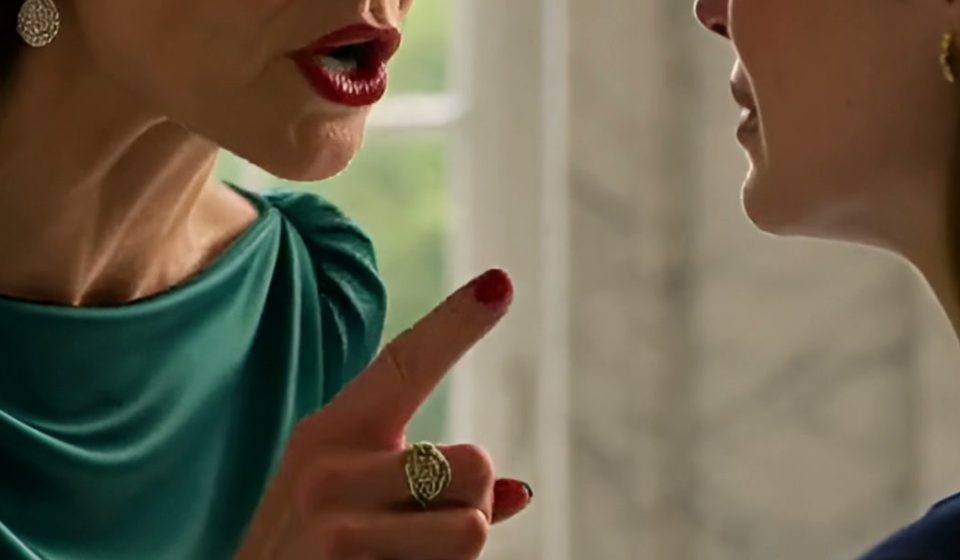
Gallery Owner’s Fiancee Hurled The Assistant’s Painting To The Floor, Then She Named Who Sent Her

Art collector Roman Voss watched a crying gallery girl clutch a battered watercolour of a blue door… But when she said the name of the woman who gave it to her, his champagne glass shattered on the marble floor.
The morning light came through the tall windows of Carrington Row Gallery in long, clean bars, catching the white orchids on the pedestals and turning the marble floor into something almost holy.
Nora Beckett wasn’t thinking about holy. She was thinking about the bubble wrap she’d forgotten to peel from the bottom corner of the little watercolour, and whether anyone would notice before the show opened.
She peeled it now, carefully, standing at the hanging wall with the painting held against her chest. It was small—barely the size of a hardback book—and not the kind of thing that usually hung here. A blue door. Just a blue door in a white stone wall, rendered in loose, wet brushstrokes, sunlight pooling at the threshold.
She’d been told it was the most important piece in the room.
She almost believed it.
“What exactly do you think you’re doing?”
Nora turned. Celeste Harrow moved through the gallery the way weather moved through a town: you felt her before you saw her clearly, and by the time you understood what was happening, something was already ruined.
“Ms. Harrow,” Nora said. “This is the last piece. The four o’clock show—”
“I know what the four o’clock show is.” Celeste stopped two feet away, her emerald silk catching the light in a way that looked like money on purpose. “What I don’t know is why a frame-cleaning girl is making hanging decisions for my fiancé’s gallery.”
“Mr. Ashby asked me to—”
“Mr. Ashby isn’t here.” Celeste reached out and took the painting by its edge, not gently. “And this—” she turned it over once, looked at it the way you look at a receipt you didn’t ask for— “is beneath this room.”
“Please be careful,” Nora said. “The paper is—”
Celeste placed it face-down on the marble. The sound it made was soft. Worse than a crack would have been.
The room went quiet. Three waiters stopped moving. A woman in blue near the orchids turned her head. Nora heard her own breathing.
“Out,” Celeste said, and wrapped her hand around Nora’s upper arm. “You can collect your things from the service entrance.”
Nora’s eyes filled. She didn’t pull away—she’d learned early that pulling away from someone like Celeste only gave them something to talk about later. She just looked down at the painting lying face-down on the cold marble, its edges curling slightly in the light, and she thought about the woman who had given it to her.
“Let go of her arm.”
The voice came from the right. Calm. Not loud. The kind of voice that had decided something three sentences before it spoke.
Roman Voss was fifty-four years old, built like a man who had spent his thirties on job sites and his forties buying the companies that owned them. His cream linen suit was the kind of expensive that didn’t announce itself. His hair was grey at the temples and white everywhere else. He crossed the floor in four steps, and on the fourth step he caught Celeste’s wrist—not hard, just completely—and held it until she released Nora’s arm.
“Roman.” Celeste’s voice shifted into something smooth. “I was handling—”
“I saw what you were handling.” He didn’t look at her. He was already kneeling, his knees on the marble, picking the watercolour up with both hands, face-up, holding it the way you hold something you’re afraid you’ve already damaged. He studied it for a moment. Then: “Where did you get this?”
Nora wiped her face with the back of her wrist. “A woman brought it in three weeks ago. She asked me to hang it for the Sunday show. She said—” Nora stopped.
“What did she say?”
“She said a man would come to the four o’clock show who would know exactly what it meant. She said I’d know which man because he’d be the only one in the room who couldn’t look away from it.”
Roman was still kneeling. He hadn’t stood up.
“She paid me to clean the frame,” Nora said, “but the frame was already clean. I think she just wanted to make sure someone would take care of it.”
“What was her name?” Roman’s voice had changed. It had gone somewhere quieter. “The woman who brought it.”
Nora hesitated. “She said her name was Claire. She didn’t give a last name. She was—” Nora looked at her hands. “She was thin. Like she’d been thin for a while. She had the prettiest handwriting. She wrote instructions on a notecard and tucked it under the paper backing.”
“What did the notecard say?”
“‘Blue door. Sunday show. He’ll find his way home.’”
The painting trembled once in Roman’s hands.
The whole room was watching now—the waiters, the woman in blue, Celeste in her emerald silk, all of them perfectly still. Nobody spoke. Nobody moved toward him.
Roman pressed his thumb very lightly to the lower corner of the watercolour, where the brushwork was softest, where the blue of the door bled into the stone wall around it like the painter had been crying while she worked or hadn’t been, and either way it showed.
“She painted this herself,” he said. It wasn’t a question.
“I think so,” Nora said quietly. “The brushwork in the corner—she had paint under her fingernails when she came in. Old paint. Not fresh.”
Roman stood up slowly. He turned the painting over and found the notecard exactly where Nora said it would be, tucked under the backing, the handwriting small and even. He read it once. He read it again.
Then he held the painting against his chest with both arms, the way you hold something that is the last of something.
“She died,” he said. “Six weeks ago.”
Nora’s breath caught. “I’m so sorry. I didn’t know—”
“You couldn’t have.” He looked at Nora directly for the first time, really looked, and something in his expression had come undone in a way that was entirely private and entirely visible at once. “How much did she pay you?”
“Forty dollars. For the frame.”
Roman reached into his jacket. He placed a folded envelope on the nearest pedestal. “There are instructions inside. The painting is not for sale. It goes to an address on Whitmore Street. The people there will know what to do with it.” He paused. “Claire would have told you thank you. She wasn’t always good at saying it in time. I’m saying it for her.”
Nora couldn’t speak. She nodded.
Roman looked once at Celeste, who had not moved, whose smooth composure had developed, in the last four minutes, several hairline fractures.
“My lawyers will be in touch with Ashby’s lawyers about the terms of my involvement with this gallery,” Roman said. “Tell your fiancé I wish him well.”
He walked toward the door with the watercolour held against his chest, and the room stayed silent until he was through it, until they heard his footsteps cross the marble of the entrance hall and then stop, and then nothing.
Nora looked down at the pedestal. Inside the envelope, when she opened it later: a cheque made out to her name for forty thousand dollars and a handwritten line at the bottom that said only: *She talked about the blue door for thirty years. Thank you for letting her keep the promise.*
Celeste Harrow left Carrington Row Gallery that afternoon without a scene, which was the most damning thing anyone who knew her would ever say about her.
Mr. Ashby received Roman Voss’s lawyers the following Tuesday. By Thursday, the gallery had new management.
The painting of the blue door hung for eleven months in a small house on Whitmore Street, above a fireplace, where the light hit it exactly right in the mornings.