
A manager ripped pancakes from a sobbing veteran and threw him out for being one dollar short… But the soldier who walked in through the rain owned the diner.
The rain hit the windows of Harlan’s Diner in long grey sheets, and the smell of coffee and maple syrup wrapped around every booth like a warm coat. Most people had somewhere better to be on a Tuesday night. Earl Maddox did not.
He had walked four blocks in the rain to get here. His sneakers were soaked through, and the old Army cap on his head was dark with water at the brim. He was eighty-three years old, and Harlan’s had been his Tuesday place for eleven years — ever since his wife, Loretta, stopped being able to cook.
He slid into his usual booth, the red vinyl one near the window, and set his cap on the table beside his plate. The hostess knew his order without asking: short stack, butter on the side, decaf. She brought it with a smile, and Earl thanked her by name.
Then he reached into his jacket pocket and counted his money.
His hands shook the way they always did now. The tremor had started three years back and hadn’t been polite enough to leave. He lined the coins up carefully on the table, one by one, his lips moving as he counted.
Three dollars and seventy-two cents. The pancakes were four seventy-five.
He counted again. He got the same number.
He sat very still for a moment, looking at the coins. Then he picked up his fork anyway, thinking he might explain to someone, thinking they might understand, thinking eleven years of Tuesday mornings had to count for something.
He was wrong about that.
Sandra Briggs had managed Harlan’s Diner for nine years. She had a blonde ponytail she wore tight, a laminated name tag, and a policy about payment that she applied with the enthusiasm of someone who had been waiting her whole life for a rule to enforce.
She spotted the coins from across the dining room.
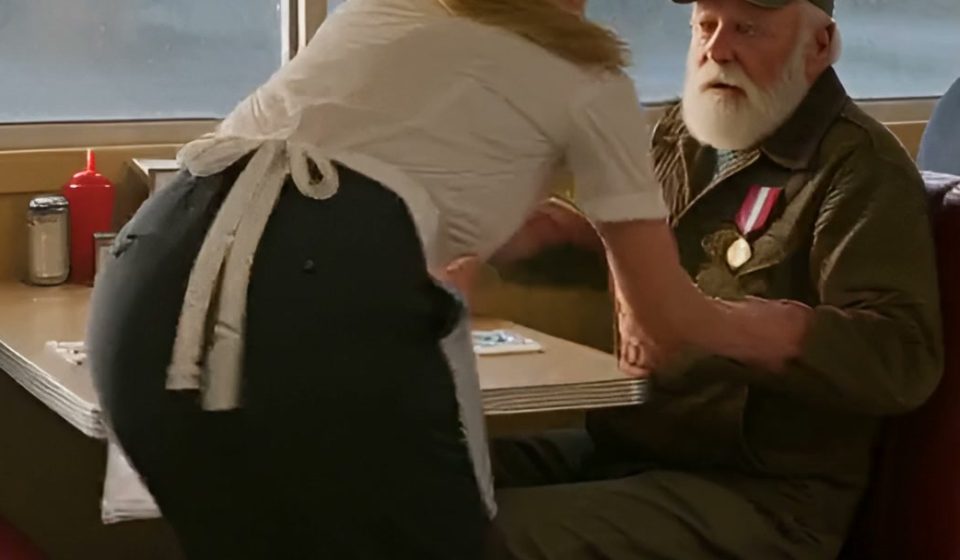
She walked over with the deliberate stride of a woman who had decided something before she arrived. She didn’t ask Earl how much he had. She didn’t ask the hostess anything. She looked at the coins, looked at the untouched pancakes, and picked up the plate.
“Wait—” Earl started.
She walked to the trash bin behind the counter and scraped the entire plate into it. Butter side down. Syrup and all.
The diner went quiet the way rooms do when everyone stops pretending not to watch.
Sandra came back to the booth. She grabbed Earl’s arm — not gently, not by the sleeve, but by the arm itself, her fingers wrapping around his thin wrist — and she pulled.
“No money, no food.” She leaned close to his ear, her voice flat and certain. “Get out, old man.”
Earl stumbled getting up. His hip caught the edge of the table. He reached out to steady himself and his hand knocked against his jacket, and the single medal pinned to his chest — a Bronze Star, worn to a soft gleam by thirty years of careful polishing — came loose from its pin and hit the linoleum floor with a sound too small for what it was.
It slid six feet and stopped under the next booth.
Earl dropped to his knees.
He didn’t try to stand first. He just went down, both knees on the cold floor, and reached toward the medal with one shaking hand. His shoulders caved. His chin dropped to his chest. And the sound that came out of him — quiet, broken, the sound of a man who had learned long ago that crying loudly changed nothing — filled the space between the booths the way water fills a low place.
Tears ran into his white beard. He couldn’t reach the medal. His arm was too short, or the floor was too far, or maybe his hands were shaking too hard to pick anything up.
At the counter, two men in their thirties stared at their coffee cups.
A woman in a booth across the aisle looked at her phone.
The hostess stood frozen behind the register, her face pale, her hands pressed flat against the counter like she was trying not to let them do anything.
Nobody moved.
The bell above the door rang.
The young man who came through it was twenty-four years old, lean and straight-backed in his Army dress uniform — green coat, brass buttons, ribbons above the left breast pocket. His cover was soaked from the parking lot. He pulled it off as the door swung shut behind him, rainwater still running from the brim.
He stopped.
He saw his grandfather on the floor.
For three seconds he stood completely still. His jaw set. His eyes moved from Earl to Sandra to the medal under the booth, and something shifted in his face — not anger exactly, something quieter and colder than anger.
He crossed the diner in ten steps.
He crouched down beside Earl and picked up the medal first. Then he put his arm around his grandfather’s back, and he lifted — steady and sure, the way someone lifts a person they have held before.
“I got you, Pop,” he said quietly. “I got you.”
Earl grabbed his arm with both hands. His fingers tightened around the green sleeve and didn’t let go.
The young man stood, bringing Earl up with him, and for a moment they just stayed like that — the old man clinging to the soldier, the soldier holding him — while the diner breathed around them.
Then the young man turned.
He pinned the medal back to Earl’s lapel. His fingers were careful and precise, the way you treat something that cost more than you can calculate. He smoothed the jacket flat. He looked at his grandfather’s face for one second — seeing him, making sure he was steady — and then he turned to face Sandra.
She was standing at the end of the counter, arms crossed, chin up, wearing the expression of someone who intended to say something about policy.
She didn’t get the chance.
The young man looked at her the way you look at something you have already decided about. His voice was not loud. It didn’t need to be.
“That’s my grandfather.” He paused. “And I own this diner.”
Sandra’s arms dropped.
The color left her face the way a light goes out — not slowly, all at once. Her mouth opened. Her hand came up and pressed against her lips. Behind her, someone at the counter made a short, involuntary sound.
The young man’s name was Cody Harlan. His grandfather, Earl, had built this diner forty years ago with his own hands after coming home from Vietnam. When Earl’s health made running it impossible, he had signed it over to Cody two years back. Cody had kept the name. He’d kept the vinyl booths and the yellow light and the hostess who knew regulars by their orders.
What he had not kept was Sandra’s employment.
He walked to the register, took out his phone, and called his operations manager in front of the entire dining room. The conversation lasted four minutes. Sandra was terminated before the rain stopped.
She left without the ponytail staying quite so tight.
Cody came back to his grandfather’s booth. Earl was already sitting, his cap back on, his hands wrapped around a fresh cup of decaf that the hostess had brought without being asked. His eyes were still wet, but he was looking at his grandson the way a man looks at something he made that turned out right.
“You didn’t have to do that,” Earl said.
Cody sat down across from him and picked up a menu he didn’t need to read.
“Yes I did, Pop.”
Earl was quiet for a moment. He looked out at the rain on the window.
“I was one dollar short,” he said, like a confession.
“You’ll never be short here again.” Cody set the menu down. “Not ever.”
The hostess brought a new short stack. Butter on the side. She set it in front of Earl and gave Cody a look that said she had wanted to do something thirty minutes ago and was sorry she hadn’t. Cody nodded at her and she nodded back.
Earl picked up his fork. His hand still shook. But he got the first bite, and the second, and his shoulders came down from around his ears by the third.
They sat there for two hours, long after the rain passed and the windows cleared. Cody ate a burger and let his grandfather talk — about Loretta, about Tuesday mornings, about a diner that had been a place worth walking four blocks in the rain to reach.
Before they left, Cody wrote one instruction on a card and left it at the register. It was laminated by the following morning and slipped under the counter glass where the staff would always see it.
*Earl Maddox — Table 4, window booth. His meals are on the house. Every Tuesday. No exceptions.*
Earl came back the next Tuesday. And the one after that. And every Tuesday for the six years that followed, he hung his wet cap on the hook by the door, slid into his booth, and waited for his short stack.
Nobody ever counted his coins again.