
Billionaire yacht owner Roman Voss watched Mira, twenty-two, lift a fallen bracelet from the teak deck… But when she whispered “this was buried with my mother,” every guest on that boat went completely still.
The superyacht *Solaris* cut a white line through the harbor at golden hour, its teak deck crowded with money and noise. Mira weaved between guests with a champagne tray, her black uniform pressed, her smile practiced. She was invisible in the way all servers are invisible at parties like this.
Then the tray left her hands.
Diana Ashworth, fifty-three, in a gold gown that cost more than Mira’s annual salary, had knocked it clean with one sweep of her arm. Crystal flutes shattered across the deck. The music stopped. Every face turned.
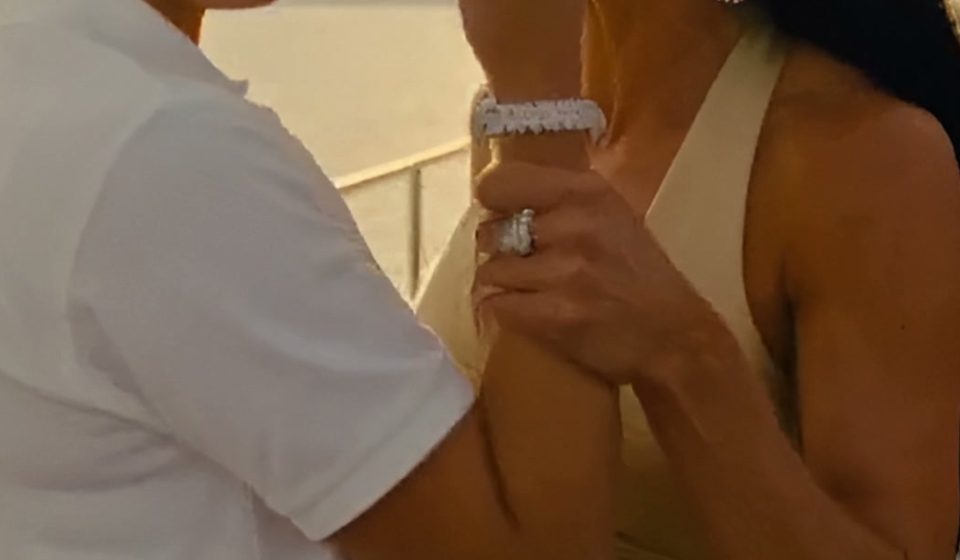
“You clumsy little thief,” Diana said, her voice carrying over the whole deck. She grabbed Mira’s wrist and yanked her arm upward, pointing at the thin gold bracelet on Mira’s wrist like evidence at a trial. “That is my bracelet. I want security up here. Now.”
Mira shook her head. “I’ve had this since I was twelve. It was my mother’s.”
“Your mother?” Diana laughed, sharp and ugly. “That piece is from a private jeweler in Geneva. Don’t embarrass yourself, sweetheart.”
The guests formed a loose ring. Nobody moved to help.
A hand came down on Diana’s raised forearm. Firm. Final.
Roman Voss, the yacht’s owner, was forty-one, broad-shouldered, with sun-dark skin and calm grey eyes that people learned not to argue with. He’d built three shipping companies from nothing and lost a wife to cancer at thirty-six, and both things showed in his face.
“Let go of her arm,” he said quietly.
Diana released Mira and stepped back, recalibrating. Roman Voss didn’t raise his voice at parties. He didn’t have to.
“Roman, that girl is wearing stolen property,” Diana said, switching to her wounded-guest voice. “I expect you to handle this appropriately.”
“I saw what happened, Diana. You knocked her tray and you’re embarrassed about it.” He said it the way you say something that’s simply true. “Go enjoy the bar.”
Diana’s jaw tightened. She smoothed her gown, lifted her chin, and walked away toward the stern, heels clicking on teak.
That was when it fell.
The bracelet slipped off Diana’s wrist as she turned, hit the deck with a small bright sound, and skidded to a stop near Mira’s shoe.
Mira bent and picked it up. She held it in her palm.
The color left her face.
It was a narrow gold cuff, hand-engraved with a pattern of tiny olive branches. A deep scratch ran across the inside where the clasp had been repaired. And there, stamped in the gold in a font so small you’d need to know to look, were two initials: *E.C.*
Elena Calder. Her mother’s name.
“This—” Mira’s voice broke. She turned it over. “This was buried with my mother. Ten years ago. I put it on her wrist myself before they closed the casket.”
The deck was quiet except for the water and the distant sound of the marina.
Roman stepped closer. “What did you say?”
Mira looked up at him, eyes bright with something between grief and terror. “My mother died when I was twelve. She wore this every day. I buried her in it.” She held it out like it might burn her. “How does Diana Ashworth have my dead mother’s bracelet?”
Roman took it gently from her hand. He examined the initials. His expression didn’t change, but something moved behind his eyes.
“What was your mother’s name?” he asked.
“Elena Calder.”
He was quiet for three long seconds.
“Come with me,” he said.
He took her to the main salon, away from the guests and the broken glass. His assistant, a sharp-faced young man named Cal, was already on his phone before Roman even asked.
“Diana Ashworth,” Roman said to him. “Find out where she got the bracelet. When, who from, and for how much. I want it in twenty minutes.”
Mira sat on the edge of a cream leather banquette, the bracelet on the table between them. She kept looking at it the way you look at something impossible.
“You knew her,” Mira said. It wasn’t quite a question.
Roman sat across from her. He laced his fingers together on the table. “I didn’t know your mother. But ten years ago, I hired a man to liquidate the estate of a shipping partner who died in debt. His name was Gerald Marsh.” He paused. “I didn’t ask enough questions about where everything went.”
Mira stared at him. “Gerald Marsh. That’s the man who managed my mother’s estate after she died.” Her voice went flat and careful. “She had debts from her illness. He handled everything. I was twelve. I didn’t know what handling everything meant.”
“It meant stripping the grave,” Roman said.
He said it plainly, without flinching from it. Mira appreciated that more than she could say.
Cal came back in eleven minutes. He set a printed document on the table: a private auction manifest from eight years ago. Lot 47. *Gold cuff bracelet, engraved, Geneva maker’s mark.* Sold to Diana Ashworth for three thousand dollars.
Below it, a second document. Gerald Marsh’s liquidation records. Estate of Elena Calder, deceased. Personal effects sold to cover outstanding debts.
The bracelet had been itemized. Sold. The woman Mira had dressed for burial had been picked apart like a yard sale.
“He stole it from her coffin,” Mira said.
“Or before she went in.” Roman’s voice was low. “Either way, it was theft. Diana bought it without knowing, but Marsh committed fraud against a minor. You were the heir. You were twelve years old, and nobody told you.”
Mira pressed both hands flat on the table. She was holding herself very still, the way people do when they’re deciding whether to fall apart.
“He’s still practicing,” she said. “Gerald Marsh. He still manages estates. He’s managed six estates in our county in the last three years.”
Roman looked at her steadily. “Not for much longer.”
Cal had a lawyer on the phone within the hour. Not a referral. Roman’s own attorney, Leonard Kaye, the kind of man who billed four hundred dollars a minute and whose calls got returned.
“The minor-heir fraud is clean,” Kaye told them on speaker. “Marsh sold property belonging to Mira Calder without her knowledge or consent while acting as fiduciary. If the liquidation records are accurate, that’s a criminal matter, not civil. We go to the DA.”
Diana Ashworth appeared in the salon doorway with her second martini and what remained of her dignity. “Roman, I really think we should discuss—”
“Leonard,” Roman said into the phone, “I’ll call you in five.” He hung up and looked at Diana. “You bought that bracelet at auction eight years ago. That makes you a victim of the same fraud, not a perpetrator.” He said it calmly. “But the bracelet belongs to Mira. I’d like you to formally relinquish your claim tonight, in writing, before you leave this boat.”
Diana looked at Mira. Something shifted in her expression — the first honest thing Mira had seen on her face all evening.
“I didn’t know,” she said stiffly.
“No,” Mira agreed. “You didn’t.”
Diana set her martini down. “Fine. Cal, draft whatever you need.”
Gerald Marsh was arrested fourteen weeks later. The DA charged him with five counts of estate fraud spanning a decade. Mira’s case was the clearest, the most documented, and the one that opened the investigation into the others.
At the sentencing, Mira sat in the third row. She was not there to speak. She’d already given her statement. She was there because her mother had deserved a witness for what was done to her, and Mira was the only one left to be it.
Marsh got four years. His license was revoked permanently.
Mira wore the bracelet to the courthouse.
She wore it on her wrist the way her mother had, every day — through the drive home, through the groceries, through an ordinary Tuesday evening that felt, for the first time in ten years, like it might lead somewhere.
Roman had offered her a full-time position managing crew hospitality across his fleet. She’d said she’d think about it, which both of them understood to mean yes.
She sat at her small kitchen table that night and held her wrist up so the last of the daylight caught the gold. The tiny olive branches. The scratched clasp. The initials, almost invisible, that had always been hers.
“I got it back, Mom,” she said to the empty room.
She meant the bracelet. She meant more than that.