
The billionaire caught his bride’s wrist as she slapped a music box from a young maid’s hands… But when the maid whispered what the box played every night, he went completely still.
The sunroom smelled like white roses and fresh paint. Every surface was being stripped bare.
Elena Marsh stood in the center of the glass-walled room, directing two removal men with the calm authority of someone who had already decided what this house would become. The crates lined the marble floor — books, photographs, a needlepoint cushion, a small bronze figurine. All of it had belonged to Catherine Hale, the late mother of the man Elena was marrying in six weeks.
“Everything goes,” Elena said, pulling on a pair of white gloves. “She wants a clean start. Well, she’s getting one.”
The removal men didn’t answer. They rarely did.
In the corner of the sunroom, half-hidden behind a tall crate, a young housemaid named Clara pressed a small wooden music box against her chest. Clara was twenty-two, slight, with dark brown hair pinned back and a gray uniform two sizes too large for her. She had worked at the Hale estate for fourteen months. She had not said a word for the past forty minutes, watching things disappear.
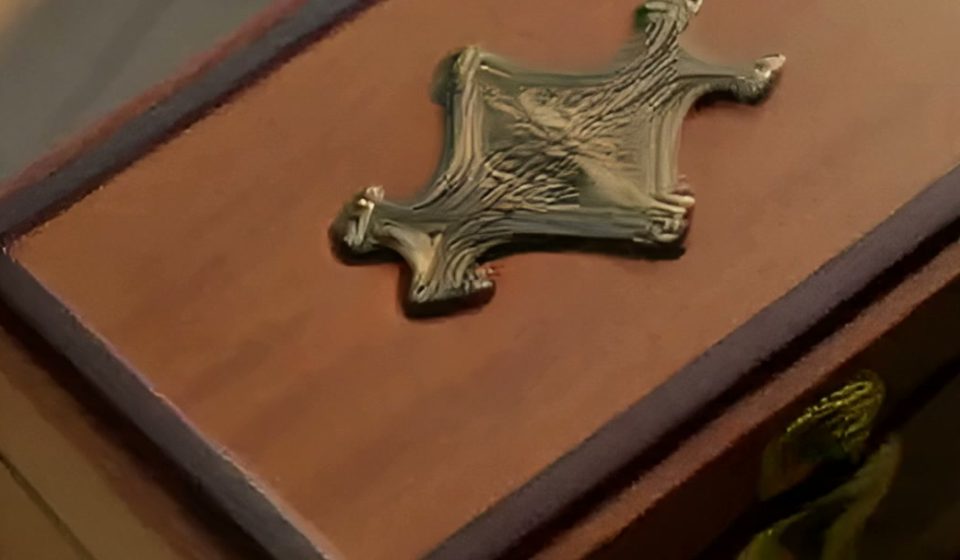
The music box was plain. No carvings, no gilding. Just smooth worn oak, a small brass key in the back, and a latch that had been opened so many times the hinge had gone soft. It was the most ordinary object in the room.
Clara had pulled it from the third crate before anyone sealed the lid.
“What is that?”
Elena’s voice came from directly behind her.
Clara turned. She had not heard the woman cross the room.
“It’s just a music box, Miss Marsh. It belonged to Mrs. Hale. I thought—”
“I can see what it is.” Elena’s expression didn’t shift. “Put it in the crate.”
“I only wanted to keep—”
“You don’t work here to want things.” Elena’s voice dropped to something thin and sharp. “That is not yours. Nothing in this house is yours. Now put it in the crate, or I’ll put it there myself.”
Clara’s hands tightened around the box. Her chin stayed up, but her lip had started to tremble.
Elena reached out and slapped the box cleanly from her hands.
It struck the marble floor with a bright, hollow crack. The latch popped open. And then, without anyone touching it, the mechanism inside caught — the small brass cylinder began to turn — and the music box played.
It played four bars of a lullaby. Simple, slow, a little out of tune from age. Then it stopped.
The removal men had both gone still.
Clara dropped to her knees on the cold marble and cupped the box in both hands, checking the hinge, the latch, the key. Her shoulders were shaking. Tears dropped straight off her jaw onto the floor.
Elena stepped forward to take it.
“Don’t.”
The word came from the doorway.
James Hale was thirty-four, tall, in a charcoal suit he’d worn since the morning board meeting and hadn’t bothered to change. He had his mother’s jaw and his father’s eyes, which was something people had always told him and he had never known what to do with. He was not a man who raised his voice. He didn’t need to.
He crossed the room in four steps, and his hand closed around Elena’s wrist before she could reach the box.
Not hard. Not twisting. Just — stopped her.
Elena looked at his hand on her wrist. Then she looked at his face. Whatever she found there made her take a step back on her own.
James let go.
He crouched down in front of Clara, picked up the music box from the floor, and held it out to her.
Clara took it. She was trying very hard not to make any sound while she cried, and failing at it slightly.
“It’s alright,” James said quietly. “It’s not going in the crate.”
Clara pressed her lips together. She looked at the box in her hands. Then she looked up at him.
“She used to wind it for me,” she said. Her voice was barely there. “Every night. I was very small. I didn’t — I didn’t have anywhere else to go that winter, and she let me stay in the east room off the kitchen, and every night before she turned the light off she would wind it and set it on the windowsill.”
James looked at her.
He had never seen this girl before in his life.
He had inherited the estate eleven months ago. He had met the staff at a formal introduction the week after the funeral — ten people, names on a clipboard, handshakes in a line. He had not been home since. He had barely been home before that.
“What’s your name?” he said.
“Clara.” She swallowed. “Clara Webb.”
“How old were you? When you stayed in the east room?”
She thought about it. “Four. Maybe five. I was my mother’s sister’s child. My mother had — she was in hospital, and my aunt couldn’t manage, and someone told her to ask at the house.” A pause. “Mrs. Hale didn’t ask any questions. She just made up the bed and brought me supper and wound the box.”
James sat back on his heels. He looked at the music box. He looked at Clara.
The lullaby was still faintly ringing in the room, the way a note rings after a bell, even when the bell has stopped.
“She never told me,” he said.
“She probably thought you’d find it strange,” Clara said. “A stray child in the kitchen wing. She was — she was very private about kind things. Like she was embarrassed by them.”
Something in his face shifted. Not breaking, exactly. Just — giving way, a fraction, the way old wood gives when the temperature changes.
“She was,” he said. “She really was.”
Elena had not left the room. She stood near the window with her arms folded, her white gloves still on, watching this exchange with the expression of someone waiting for a scene to end.
“James,” she said. “The dinner is in three hours.”
He stood up. He didn’t look at her.
“Find somewhere else to put these things,” he said to the removal men. “The east storage room. Nothing leaves the property.”
“James—”
“Elena.” He turned to face her fully, and his voice was still quiet, but there was nothing soft about it. “My mother opened her house to a frightened child and wound a music box for her every night until she wasn’t frightened anymore. That’s what this box is. And it’s staying.”
Elena looked at him. Then she looked at Clara. Then she looked at the white gloves on her hands as if seeing them for the first time.
She said nothing.
She left the room.
The dinner that evening was a small affair — twelve guests, a caterer, candles down the center of the long dining table. Elena sat at one end, poised and appropriate, and James sat at the other, and they were perfectly civil to each other across the length of the room.
He had placed the music box on the sideboard behind his chair.
Two of the guests noticed it and asked what it was.
“Something my mother kept,” he said. Both times. Nothing more.
After the guests had gone and the caterer had packed up and the house was quiet, James walked through the kitchen wing to the east room, which was small and plain and smelled of old linen and dried lavender. He knocked on the open door.
Clara looked up from the chair by the window where she’d been sitting with the music box in her lap.
“You didn’t have to keep it because of me,” she said.
“I know,” he said.
“I can find another position. I don’t want to make things difficult.”
“You haven’t made anything difficult.” He leaned against the doorframe. “I want to ask you something, and you don’t have to answer it.”
She waited.
“All those years,” he said. “Did she ever say anything to you? About why she did it? Just — opened the door and let you stay?”
Clara thought about it for a long time.
“She said she’d learned from someone that the loneliest thing in the world is a child who doesn’t know if they’re wanted.” She paused. “She said she’d decided a long time ago that no child would ever feel that way in her house.”
James looked at the ceiling. His jaw was tight.
“Yeah,” he said quietly. “That sounds right.”
He straightened. He looked at the music box.
“Wind it, if you want,” he said. “The east room’s yours as long as you need it.”
He walked back down the corridor toward the main house.
Behind him, faint and slow and a little out of tune, four bars of a lullaby played in the dark, and then stopped, and left the air ringing.
A week later, he called Elena and ended the engagement. He was calm about it. He returned the ring by courier.
He kept the music box on his desk after that — in his office in the city, where he worked long days and answered hard questions and made difficult decisions. People who visited the office sometimes noticed it: plain, worn, no carvings. They would ask what it was.
“Something my mother kept,” he always said.
He never explained further. He didn’t need to.
Some things don’t need explaining. They just need to be kept.