Hotel Guest Ripped The Silver Comb From The Hairdresser’s Hair, Then She Named Who Braided It

Hotel chauffeur Marcus Vane watched a wealthy guest rip a plain silver comb from his young hairdresser’s braid and throw it on the marble floor… But when the girl whispered where that comb came from, his face shattered like glass.
The marble salon of the Grand Alcott Hotel glittered at seven in the morning. Crystal chandeliers threw gold across the tall mirrors. Twenty-two-year-old Lena Marsh was the first one in, as always — dark braid over her shoulder, white uniform pressed smooth, already setting out folded towels before the first client arrived.
She hummed quietly while she worked.
“That’s mine.”
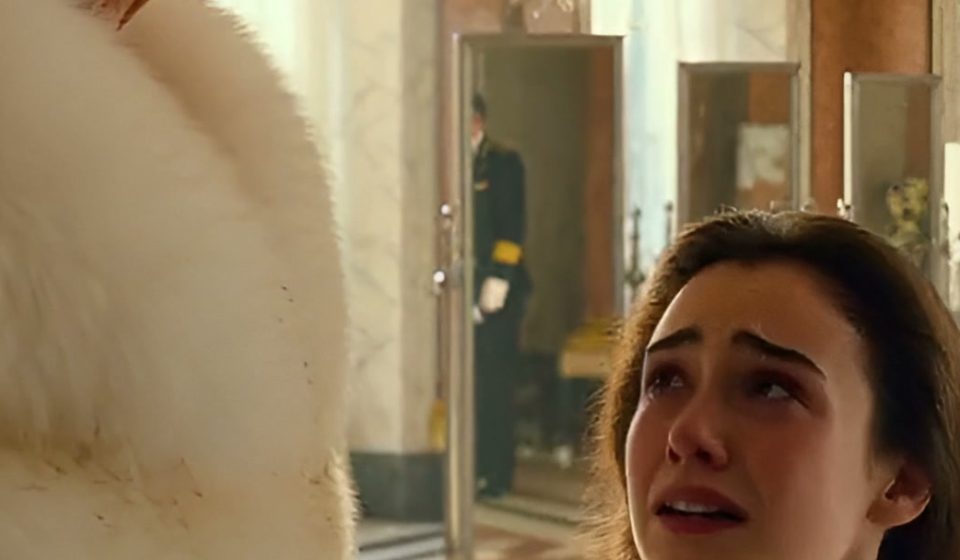
Lena turned. Mrs. Dolores Whitmore, sixty-three, platinum hair set hard as a helmet, white fur stole despite the June heat, was pointing at the small silver comb in Lena’s braid. The kind of comb that cost nothing. Oval, plain, a tiny chip at one corner.
“I’m sorry?” Lena said.
“That comb. It belongs to me. I left it here last Thursday.” The woman’s voice didn’t rise. It didn’t need to. Three stylists froze behind their chairs.
“Ma’am, this is mine. My mother gave it to—”
Mrs. Whitmore grabbed the braid.
The yank was sharp and sideways. Lena’s head went with it. The comb scraped free. The older woman dropped it on the floor like a piece of gum and straightened her stole.
“Thief,” she said. Loud enough for the whole salon to hear.
Lena’s eyes burned. She pressed her lips together and bent to pick it up.
Mrs. Whitmore reached for her wrist.
A hand came in from the left and caught the guest’s wrist in mid-air.
“Don’t touch her.”
The voice was quiet. That was what made it dangerous.
Marcus Vane — thirty-one, broad-shouldered, navy chauffeur’s uniform, jaw like a locked door — held Mrs. Whitmore’s wrist at waist height and looked at her with an expression that wasn’t anger. It was something colder than anger.
He had been waiting by the salon entrance. He waited there every morning. Nobody had ever noticed him notice things.
Mrs. Whitmore went very still.
“You work for me,” she said.
“I drive for the hotel,” Marcus said. “I don’t work for you.”
He released her wrist and stepped aside. Mrs. Whitmore pulled her stole tighter, looked once around the room at the frozen stylists, and walked out.
The door swung shut.
Nobody breathed for three full seconds.
Then Marcus crouched down, right there on the marble floor, and picked up the silver comb. He turned it over once in his big hands, studying the chip at the corner, and held it out to Lena.
“Here.”
She took it. Her fingers were shaking. She pressed it against her palm like something she was afraid would disappear again.
“Thank you,” she said. Her voice cracked on the second word.
“You don’t have to thank me.”
“She called me a thief in front of everyone.”
“I know.” He didn’t stand up yet. He stayed crouched, eye level with her, which felt strange given how large he was. “She was wrong.”
Lena looked down at the comb. A tear dropped onto the silver and she wiped it away fast, embarrassed.
“It’s not even worth anything,” she said. “It’s just — my mother put it in my hair. This morning. I mean—” She stopped. She laughed once, a sound that wasn’t quite a laugh. “Not this morning. She’s been gone nine years. But I put it in myself. The way she used to do it. The exact same way.”
Marcus went very still.
His eyes dropped to the comb in her hand. Then back to her face.
Something happened to his expression. Something structural. Like a wall that had been standing so long everyone forgot it was holding something up — and now the first stone had shifted.
“What was her name?” he said.
Lena blinked. “What?”
“Your mother.” His voice had changed. Lower. Rougher around the edges. “What was her name?”
“Diane,” Lena said. “Diane Marsh. Why?”
The word hit him like a step off a curb he didn’t see coming. His jaw worked once. He looked at the comb again — at the chip in the corner, at the oval shape, at the tiny engraved line along the spine that you’d only see if you knew to look for it.
He knew to look for it.
“Where did she get it?” he said.
“I don’t know.” Lena’s voice was careful now. She was watching his face. “She always had it. As long as I can remember.”
Marcus stood up slowly. He was very quiet for a moment. The chandeliers hummed overhead. A stylist behind them set down her scissors with a small click, and no one told her to.
“I need to show you something,” he said.
He reached into the breast pocket of his uniform jacket and pulled out a wallet. From behind a folded receipt he drew a photograph. Small, worn at the edges, creased down the middle. He held it out.
It was a picture of two people. A young woman with a dark braid, laughing, her face turned toward the camera. And beside her, seventeen years younger but unmistakable, a teenage boy with the same jaw, the same locked-door expression, grinning with his whole face in a way the adult version of him apparently no longer knew how to do.
Between them, resting in the young woman’s open palm, was a small silver comb. Oval, plain, a tiny chip at one corner.
Lena stared at the photo.
“That’s my mother,” she whispered.
“Yes,” Marcus said.
“Who is the boy?”
He looked at her for a long moment.
“My name is Marcus Vane,” he said. “But when I was fourteen, my last name was Marsh. Your mother was my sister, Lena. She left after a fight with our father. I looked for her for nine years.” His voice didn’t shake. He was the kind of man who had learned, very carefully, not to let his voice shake. “I found out about you eight months ago. I took the job here because you work here. I didn’t know how to—” He stopped. “I didn’t know how to walk up to you and say it.”
The salon was completely silent.
Lena looked at the photograph. She looked at his face. She looked at the comb in her hand.
“You’re my uncle,” she said.
“Yes.”
She made a sound — not a sob, not a laugh, something that was both at once and neither — and pressed the back of her hand against her mouth.
Marcus didn’t move. He let her have the moment. He was still holding the photograph out, steady, waiting for her to take it or hand it back, whichever she needed.
She reached out and took it.
Then she looked up at him with her mother’s eyes and said, “She used to say she had a brother who was going to find her someday. She said it until—” Her throat closed. She tried again. “She said it right up until the end.”
The comb glinted in her palm. Nine years old and still sharp at the edge, still holding its shape, as if it had been waiting too.
“I know,” Marcus said quietly. “I’m sorry it took me this long.”
She held the photograph against her chest with both hands, and the salon full of strangers looked away to give her the only privacy they could offer.
Marcus stood in front of her, not moving, not pushing, just present — the way someone stands when they have finally, after a very long time, arrived exactly where they were supposed to be.