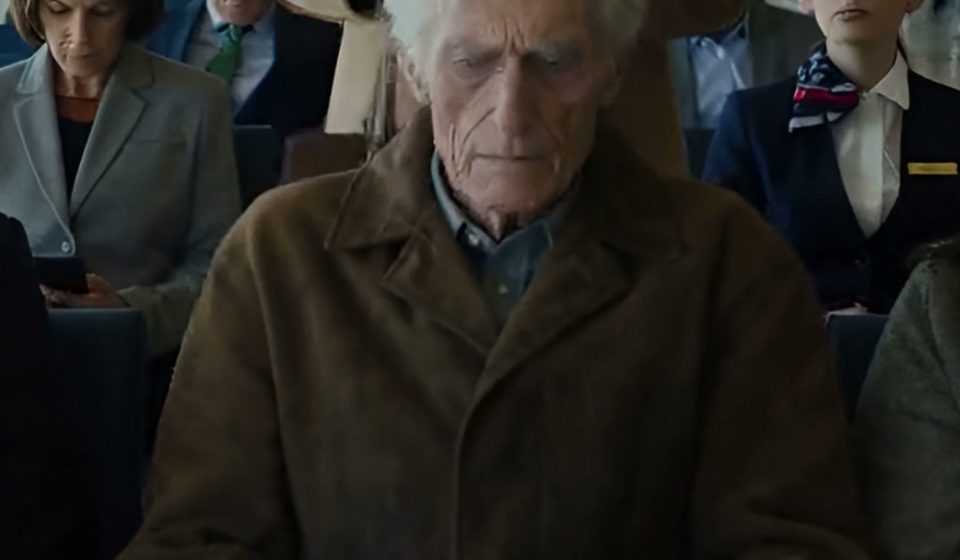

A wealthy woman screamed at a frail old man to move seats at a crowded airport gate… But the airline employee who witnessed it had the power to rewrite his entire flight.
The gate was packed. Flight 1147 to Denver, 7:40 a.m., and every plastic seat was taken except a handful scattered near the windows.
Gerald Marsh, seventy-three years old, set his plastic bag on the floor and lowered himself carefully into an empty seat. His coat was old. His shoes were older. He’d been traveling since 4 a.m. to get here.
He barely had time to exhale before the woman beside him stood up.
She was in her mid-forties, a camel-colored coat that probably cost more than Gerald’s monthly social security check, hair pulled tight, carry-on luggage with a designer tag. She grabbed her handbag like he might reach for it.
“Don’t sit next to me.” Her voice cut across the entire gate. “Go sit somewhere else.”
Gerald looked at the floor.
He didn’t argue. He never argued. Seventy-three years of surviving had taught him that arguing with a certain kind of person only made it worse.
“I’m sorry,” he said quietly. “I didn’t mean to bother you.”
The woman wasn’t satisfied. She turned to face the rows of travelers around her, as though seeking confirmation, as though she needed an audience.
“Why is he even allowed in here? He smells.”
A few people glanced over. A man in a business suit studied his phone with sudden intense focus. A young couple near the window looked at each other and then away. A mother pulled her child slightly closer, not to protect him from Gerald, but to avoid being part of whatever this was.
Nobody said a word.
Gerald put both hands on his knees and began to push himself up.
“I’ll move,” he said. “It’s fine. I’ll find somewhere.”
He was already scanning the gate for another seat, already doing the math of his bad hip and how far he could walk, already preparing to disappear the way people like him had learned to disappear.
He didn’t find another seat. There wasn’t one.
“Sir.”
The voice came from his left. He turned.
A young woman in a navy airline uniform was crouching in front of him. She had stopped mid-stride, turned around, and come back. Her name tag read KELLY. She was maybe twenty-six, with steady brown eyes and the kind of calm that didn’t come from training — it came from character.
“Please don’t move,” Kelly said. “You were here first. You’re absolutely fine right where you are.”
The woman in the camel coat made a sharp sound. “Excuse me. I’m a Platinum member. I’ve been flying with this airline for eleven years. I want this man moved.”
Kelly stood up slowly. She turned to face the woman with an expression that was completely neutral, which somehow made it more powerful than anger.
“I understand,” Kelly said evenly. “You’re welcome to find another seat.”
The woman’s face went red. “This is unacceptable. I’m going to report you.”
“You’re welcome to do that too.” Kelly didn’t blink. “My name is Kelly Marsh. M-A-R-S-H. I’ll be happy to give you the customer service number.”
Then Kelly turned back to Gerald. She held out her hand.
“May I see your boarding pass, sir?”
Gerald looked at her like she might be making a mistake. Like this might be a trap of some kind. He’d lived long enough to be suspicious of sudden kindness.
But he reached into his coat pocket and gave her the pass.
Kelly looked at it for a moment. Then something shifted in her face — not surprise, exactly. More like resolve.
“Mr. Marsh,” she said. “We have an open seat in first class this morning. I’d like to move you up front. Will you come with me?”
Gerald stared at her.
“I — I don’t have a first class ticket,” he said.
“You do now.” Kelly smiled, and it was the real kind. “It’s a complimentary upgrade. You qualify.”
She helped him stand, gently, giving him time to get his balance. She picked up his plastic bag herself and held it carefully, like it contained something valuable.
Gerald Marsh looked like a man who hadn’t been treated gently in a very long time and didn’t quite know what to do with it. His jaw worked silently for a moment.
“Thank you,” he finally managed. “That’s — thank you.”
“Of course,” Kelly said. “Right this way.”
They walked together toward the jetbridge door.
Before they passed through, Kelly paused. She turned and looked back at the gate.
At the woman in the camel coat.
She didn’t say anything. She didn’t have to. The entire gate was watching now. The man in the business suit had put his phone down. The young couple near the window had stopped pretending not to look. The mother had turned fully around in her seat.
Every single person at gate B-14 had seen what happened.
The woman in the camel coat stood alone in the middle of it, chin up, handbag clutched to her chest, surrounded by the specific silence of people who have collectively decided what they think of you.
Her Platinum status didn’t help. Her eleven years didn’t help. Her expensive coat didn’t help.
She sat back down.
She did not make eye contact with anyone for the remaining forty minutes until boarding.
In seat 2A, Gerald Marsh accepted a glass of orange juice from a flight attendant and looked out the oval window at the tarmac below.
The seat reclined. There was a blanket. The footrest extended.
He hadn’t flown first class once in seventy-three years.
He pressed the folded boarding pass against his knee — the new one, reprinted, with 2A printed in the corner — and held it there like proof of something.
When the plane lifted off, Gerald Marsh closed his eyes.
He slept the whole way to Denver. Deeply. Peacefully. Like a man who had just been reminded that the world, occasionally, contained Kelly Marsh.
Back at gate B-14, the woman in the camel coat boarded with Group 4, walked down the aisle past the first-class cabin with her eyes fixed forward, and took her middle seat in row 24.
She did not sleep.