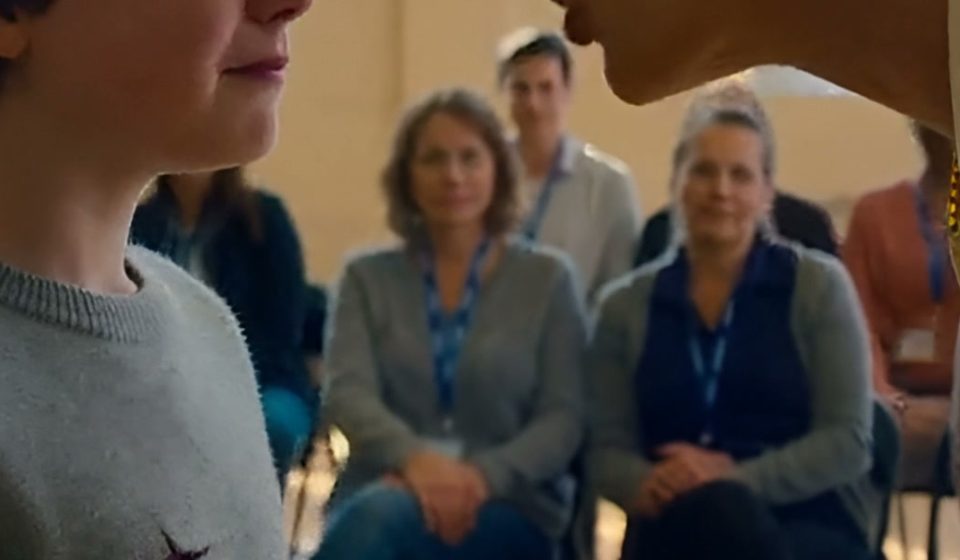

A wealthy mother snatched a ten-year-old’s first-place certificate and tore it in half at the school awards ceremony… But the woman who watched her do it was the principal — and the boy’s mother.
The gym smelled like floor wax and popcorn. Rows of metal folding chairs scraped against the hardwood as parents jostled for views of the low stage, and the afternoon sun came through the high windows in long gold strips, landing on the handmade banner that read: LINCOLN ELEMENTARY SCIENCE FAIR — FIRST ANNUAL.
Marcus Delgado, ten years old, stood at the edge of the stage with his certificate rolled in both hands, afraid to breathe on it.
It was the most beautiful thing he had ever touched. Thick cream paper, his name printed in dark ink, a gold seal pressed into the corner. He had read his own name three times to make sure it was real.
His sneakers had a hole in the left toe. His grey sweater had been mended at the elbow twice, once by his grandmother and once by himself. He hadn’t slept well in weeks because the apartment got cold at night and he’d been up reading about photosynthesis by flashlight under two blankets. But none of that mattered right now, because the certificate was real, and the applause had been real, and his name had come out of Principal Soto’s mouth over the microphone in front of everyone.
He stepped down from the stage and smiled.
That was when Diana Hartwell moved.
She was in the front row, cream blazer, dark hair pulled back so tightly it shone, a strand of gold at her throat that probably cost more than Marcus’s family paid in rent. Her son, Bryce, sat beside her in a pressed blue oxford, his second-place ribbon face-down on his knee.
She stood up before the applause had fully died.
She crossed to Marcus in four steps, and before he could register what was happening, she pulled the certificate from his hands with a single sharp motion, like she was taking a magazine off a rack.
She tore it in half.
The sound was small and enormous at the same time — a clean paper crack that cut through the noise of the gym and left a silence behind it.
She dropped the two pieces on the floor at Marcus’s feet.
“Kids like you don’t win here.”
She said it quietly, almost gently, which was somehow worse. She smoothed the front of her blazer and looked down at him the way you look at something spilled on a tile floor — briefly, with mild irritation, before stepping around it.
Marcus stood completely still for a moment.
Then his face did something that several parents who were watching later said they would never forget. It didn’t collapse all at once. It went in stages — the smile first, dropping like a curtain cut from its rail, then the chin beginning to tremble, then the eyes going bright and wet before the first tear actually fell.
He knelt down on the gym floor and began picking up the pieces.
“I studied every night for this.”
He wasn’t saying it to anyone in particular. He was saying it to the torn paper in his hands, trying to fit the two halves back together, the gold seal cracked down the middle now. His shoulders shook.
Around him, the gym had gone the particular kind of quiet where everyone is watching and no one is moving. Parents in folding chairs craned forward. A father near the back stood halfway up and then sat back down. A teacher at the side of the room pressed her hand over her mouth. A cluster of fifth-graders near the bleachers stared with wide open faces.
Nobody moved. Nobody said a word.
Diana Hartwell was already walking back toward her chair, one hand resting lightly on Bryce’s shoulder, murmuring something into his ear.
Bryce had gone pale. He was staring at Marcus on the floor with an expression his mother didn’t see and couldn’t interpret — something between guilt and horror.
Then there were footsteps.
Fast, deliberate footsteps coming down the center aisle — not running, but close to it. The kind of walk that has a destination and a purpose and has already decided what it’s going to do when it gets there.
Elena Soto was forty-three years old. She had been principal of Lincoln Elementary for six years. She wore a navy suit and the school lanyard with her ID badge, and she had been standing at the back of the gym managing the event logistics when she watched Diana Hartwell cross the floor.
She had started moving before the paper hit the ground.
She reached Marcus in seconds. She didn’t hesitate — she went straight down to her knees beside him on the gym floor, in her good suit, on the waxed hardwood, and she put both arms around him.
“I’ve got you,” she said quietly, into his hair. “I’ve got you, baby.”
Marcus pressed his face into her shoulder and cried the way ten-year-olds cry when they’ve been holding it together as hard as they can and someone finally reaches them — completely, without pretense, with his whole body shaking.
She held him for a long moment. Then she helped him to his feet, took the torn pieces gently from his hands and folded them carefully into her jacket pocket, and smoothed the back of his sweater once with her palm.
Then she turned around.
She walked directly to Diana Hartwell. She stopped close enough that Diana had to look up at her from a seated position, and the angle was not flattering to Diana, and Elena Soto knew it.
“That’s my son.” Her voice was level and clear and carried through the gym the way a voice carries in a room that is completely silent. “I’m the principal here.”
Diana Hartwell’s face went white.
Not pale. White — the color draining out of it fast, starting at her cheeks and moving down to her lips, which parted slightly. Her hand came up slowly and pressed itself flat against her mouth. The gold bracelet on her wrist caught the afternoon light.
For three full seconds, she simply stared.
“I—” she started.
“Don’t.” Principal Soto cut her off without raising her voice. “Not right now.”
She turned back to the gym, to the rows of watching parents, to the teachers frozen at the sides of the room, to the children in the bleachers with their wide-open faces, and she straightened her lanyard.
“We’re going to take a ten-minute recess,” she said clearly. “Then we’re going to continue our ceremony.”
She walked Marcus to the back hallway, sat him on the bench outside her office with a cup of water, and made three phone calls.
The first was to the school district’s events coordinator, who confirmed what Principal Soto had known before she dialed: the ceremony was an official school event, and all attendees were subject to the school’s code of conduct for parents and guests. Documented disruption, harassment of a student, destruction of district property — that last one, technically, was what the certificate was — constituted grounds for removal and a formal ban from school events.
The second call was to the district’s administrative office. She filed the incident report while Marcus drank his water and stopped shaking.
The third call was to her own mother, who had driven forty minutes to watch her grandson receive his award, and who was still sitting in the fourth row, holding her program very tightly.
“He’s okay, Mama,” she said. “Tell him five minutes.”
Then she walked back into the gym.
Diana Hartwell was still in her front-row chair, but she had shifted six inches to the left and was examining something on her phone with great concentration. Bryce sat beside her, ribbon still face-down, staring at the stage.
Principal Soto stopped at the end of Diana’s row.
“Mrs. Hartwell. I’m going to need you to gather your things.”
Diana looked up. Her composure had partially reassembled itself — the jaw was set, the posture upright, the expression moving toward indignation. “I think there’s been a misunderstanding—”
“There hasn’t been.” Principal Soto kept her voice polite and quiet. “I saw what happened from twenty feet away. So did approximately a hundred and sixty people in this room.” She paused. “You are being removed from this event. You are banned from all Lincoln Elementary campus events for the remainder of this school year, pending a review by the district superintendent, which I will be requesting on Monday morning. The incident has been documented.”
Diana opened her mouth.
“Your son,” Principal Soto added, “is welcome to stay. He didn’t do anything wrong, and his ribbon is his to keep.”
Bryce looked up at that. His eyes were red.
Diana Hartwell stood. She gathered her purse with slow, precise movements, the kind that are meant to project dignity. Two parents near the aisle moved their chairs slightly to let her through without being asked. She walked the length of the gym to the exit doors.
The room watched her go.
Nobody said anything. They didn’t need to.
The door swung shut behind her.
Principal Soto stood at the podium for a moment, adjusted the microphone, and looked out at the room.
“We’ll resume in four minutes,” she said. “Thank you for your patience.”
In the hallway, Marcus had finished his water. He was looking at the two torn halves of his certificate, which his mother had smoothed flat on the bench beside him.
“Can they fix it?” he asked when she came back.
“Better than that,” she said. “Come with me.”
She walked him to the school office, where the district certificate template was still open on the administrative assistant’s computer. Eight minutes later, a new certificate emerged from the printer — same cream paper, same dark ink, same gold seal, his name in the center, perfectly intact.
She held it out to him with both hands.
He took it the same way.
Then she walked him back through the side door of the gym, back to the stage, and she went back to the podium.
“Before we continue,” she said into the microphone, “I’d like to re-present the first-place Science Fair award.” She looked at her son. “Marcus Delgado. For his research project on photosynthesis and light spectrum absorption, which the judges unanimously scored highest in the competition.”
She held out the new certificate.
Marcus walked up to the stage for the second time that afternoon. His sneaker still had the hole in the left toe. His sweater was still mended at the elbow. He still hadn’t slept well in weeks.
He took the certificate and turned to face the room, and the applause that came back at him was not polite afternoon applause. It rose from the floor of the gym and bounced off the high windows and the ceiling and came down on him like warm weather.
His grandmother was on her feet in the fourth row, clapping with her whole arms, tears running freely down her face.
Bryce Hartwell was clapping too. He had turned in his chair to face the stage, and he was clapping with his palms flat and his face open and unhidden, and when Marcus caught his eye, Bryce nodded once.
After the ceremony, Bryce found Marcus by the water fountain near the exit.
“I’m sorry,” Bryce said. “What she did.” He looked at the floor, then back up. “I told her it wasn’t right. On the way over. She didn’t listen.”
Marcus looked at him for a moment. “Did you think your project was better than mine?”
Bryce considered this seriously. “No,” he said. “Yours was better. The spectral absorption part — I didn’t even know plants could do that.”
“I can show you how I set it up,” Marcus said. “If you want.”
Bryce looked surprised, then not surprised, then quietly relieved. “Yeah,” he said. “I’d like that.”
Marcus rolled his certificate carefully and tucked it under his arm.
“Next year we could do something together,” he said. “Then nobody has to come in second.”
His grandmother appeared at his elbow, still dabbing her eyes, and pressed his face between her palms and said something to him in Spanish that made him laugh.
He walked out of the gym with his certificate under his arm and his grandmother’s hand in his and the afternoon light coming through the doors ahead of him, and the applause was still in his chest like something warm.
Diana Hartwell’s formal complaint to the district — filed the following Monday, alleging that she had been “unfairly humiliated” at a school event — was reviewed on Wednesday and dismissed the same afternoon.
The ban stood.
The superintendent’s letter to her, two paragraphs, noted in its second paragraph that the destruction of district property and the verbal harassment of a minor were not matters subject to appeal on grounds of embarrassment.
She did not return to Lincoln Elementary that year.
Marcus won again the following spring. His project, a collaboration with his new lab partner, explored how different wavelengths of light affected root growth rate in common beans grown in recycled containers.
The judges said it was the best entry they’d seen in five years.
His mother presented the award this time, both certificates — the old torn one she’d had framed for his bedroom, and the new one she handed him on stage.
The gym came up off its feet before she’d even finished saying his name.