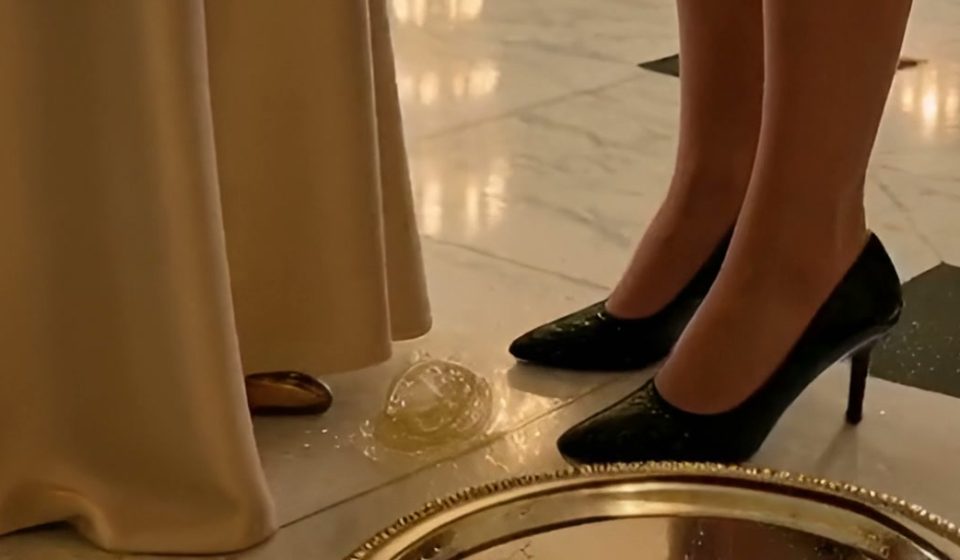

Hotel owner Roman Hale watched a young waitress drop to her knees on cold marble while a guest screamed at her… But when he grabbed the woman’s wrist and turned to the girl, he saw the bracelet — and went completely white.
The champagne hit the marble floor at 4:47 in the afternoon, and every conversation in the lobby of the Hale Grand stopped.
Lily Chen had worked the Thursday reception for three years without incident. She was twenty-two, slight, with dark hair pulled back under a white cap, and she’d been crossing the lobby with a tray of twelve glasses when Mrs. Patricia Wynn’s silk-covered elbow caught the edge.
The crash was enormous in the quiet.
“You stupid girl.” Patricia Wynn rose from her chair, her cream silk dress unmarked, her voice carrying to the revolving door. “On your knees. Pick every piece up. Now.”
Lily went to her knees without a word. She’d learned, in three years, that arguing cost more than it saved.
Around her, forty guests in evening clothes said nothing. Three colleagues near the check-in desk looked at the floor. The concierge found something to study in his computer screen.
“Every piece,” Patricia said again, stepping closer. She reached down to take hold of Lily’s arm.
A hand caught Patricia’s wrist in the air — not hard, but absolutely final.
Roman Hale was sixty-four, silver-haired, built like a man who had once worked construction and never entirely stopped. He wore a white dinner jacket every Thursday because his mother had asked him to once and he’d never found a reason to change. He stood six-two, and when he appeared in his own lobby it was always without announcement.
“Mrs. Wynn,” he said, his voice quiet enough that people had to stop breathing to hear it. “Your car will be ready in three minutes. I’ll have your account settled at no charge. But you’ll wait outside.”
“This child broke—”
“Outside,” Roman said. The single word closed the conversation.
Patricia Wynn pulled her wrist free, gathered her bag, and crossed the lobby without looking at anyone. The revolving door ate her, and the lobby exhaled.
Roman crouched beside Lily on the marble. She was still collecting glass with her bare hands.
“Stop,” he said. “You’ll cut yourself.”
“I’m fine,” Lily said. She didn’t look up.
“That wasn’t a concern, it was an order.” He said it without heat, and something in his tone made her go still. He took the largest shard from her fingers and set it on the tray.
She looked up then, and he saw her eyes — grey-green, with a specific quality of steadiness in them, the kind that doesn’t come from ease but from a long practice of enduring things without flinching. Roman had seen that look in exactly one other person in his life.
He went very still.
His gaze dropped to her wrist. The sleeve of her uniform had pulled back when she reached for the glass. On her left wrist was a thin silver bracelet, plain, with no stone and no engraving — just a small clasp in the shape of a leaf, tarnished with age.
The blood left his face.
“Where did you get that?” His voice came out different. Not the lobby voice. Something older.
Lily looked at the bracelet, then at him. “It was my mother’s.”
“What was your mother’s name?”
She frowned — the question was strange, his face was strange, all of it was strange. “Anna. Anna Chen. She went by Anna, but her given name was—” She stopped. Looked at him more carefully. “Why are you asking me this?”
“What was her given name?” Roman said. He was still crouching, eye to eye with her on the marble, and his hands — big hands, a working man’s hands — were shaking.
“Annalise,” Lily said. “Annalise Hale. She said she took her stepfather’s name when she was small but she never used it because—” She stopped again. “Sir, you’re scaring me.”
“I had a sister,” Roman said. He said it like a man reading a sentence he had always known was there but hadn’t been able to find. “Younger by nine years. She ran away at seventeen. I looked for her for fourteen years. I stopped — my mother made me stop because she was getting old and I was running myself apart and we didn’t — we couldn’t—”
He wasn’t finishing sentences. That wasn’t Roman Hale. His staff had never seen Roman Hale not finish a sentence.
“She died,” Lily said quietly. “Four years ago. She was sick. She never talked about family, but right at the end she gave me the bracelet and she said — she said it belonged to someone who would know what it meant.” She turned the bracelet on her wrist. “I didn’t know what that meant. I just kept it.”
Roman reached out very slowly and touched the small leaf clasp with one finger. His mother had bought that bracelet for Annalise’s fifth birthday. He had been fourteen and he had helped choose it. The leaf clasp had been Annalise’s idea because she’d said she wanted something that grew.
He had not seen it in forty-seven years.
“She’s gone,” he said. It wasn’t a question. He already knew the answer but the sentence needed to exist in the air.
“Four years ago,” Lily said again, gently.
Roman Hale sat on the marble floor of his own lobby, in his white dinner jacket, and put his face in his hands.
Lily sat with him. She didn’t speak. She didn’t call anyone over. Around them, the lobby staff moved very quietly to gather the glass and the tray, and the remaining guests turned away with the instinct of people who recognize a moment that doesn’t belong to them.
After a long time Roman lowered his hands. His eyes were red. He looked at Lily the way you look at something you thought was gone from the world.
“You have her eyes,” he said. “Exactly her eyes.”
“People have said that,” Lily said. “I didn’t know whose.”
“Mine too,” Roman said. “It’s a family thing.” He said the last three words as if testing them, as if they were a door he was opening after a very long time.
Lily looked at him. He was a stranger. He was also, apparently, her uncle. She was not sure yet what those two facts added up to, but she could feel them settling into her like stones finding the bottom of still water.
“What happens now?” she asked.
“I have a lawyer,” Roman said. “A good one. We’ll do whatever needs to be done to make it official.” He paused. “I have a house in Maine where my mother lived. She never sold it. I couldn’t.” He looked at the bracelet once more. “Annalise used to catch fireflies off the back porch every summer. She’d bring them inside in a jar and my mother would make her let them go at midnight.”
Lily’s breath caught. “She told me that story,” she said. “She told me about the fireflies. I always thought she made it up.”
“She remembered everything,” Roman said. He got to his feet slowly, the way a man does when his legs are uncertain and his pride no longer requires him to pretend otherwise. He held out his hand to help Lily up. She took it.
They stood in the lobby, uncle and niece, the marble cold and bright around them, and for the first time in four years Roman Hale made a phone call that wasn’t about business.
“Davies,” he said, when his lawyer picked up. “I need you tonight. It’s not a problem. It’s the opposite.”
He kept hold of Lily’s hand while he talked. She let him. The tray was gone, the glass was gone, and the Thursday reception went on around them as if the world were ordinary — which it was not, and both of them knew it, and neither of them said so out loud because some things don’t need to be said to be completely, irrevocably true.
He gave her his mother’s room in the Maine house six weeks later. Lily found a jar of dried fireflies on the windowsill — Annalise must have left them. She opened the window and let the summer air in, and that was the beginning of everything that came after.