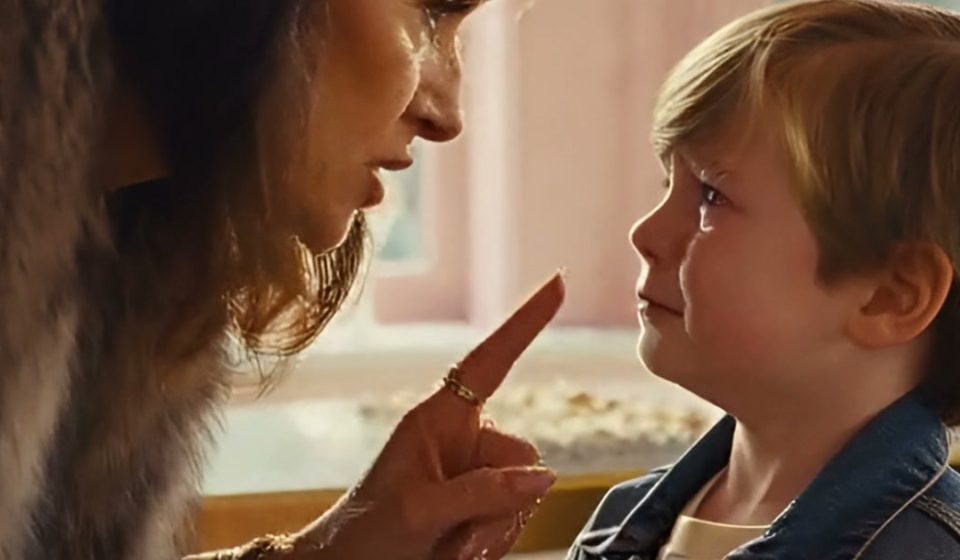

The bodyguard caught the socialite’s wrist before she could shove the six-year-old boy aside… But when the child said his mother still orders one every year, the bodyguard’s face went white as marble.
The Bellmont Patisserie on Hargrove Street was the kind of place where the croissants cost fourteen dollars and the staff smiled like they’d been trained not to blink. Gold trim ran along every shelf. Pink marble swallowed every sound. It smelled like butter and money.
Marcus Veil had been standing near the entrance for three minutes, not to buy anything. He was waiting for his client’s car. That was his job — wait, watch, and make sure nothing went wrong.
Then something went wrong.
A boy, maybe six years old, stood at the counter with a white cake box clutched to his chest like it was the most important thing in the world. Small sneakers. A striped shirt with a loose button. Dark hair that hadn’t seen a comb since morning.
He was counting coins on the glass countertop, one by one, arranging them with the seriousness of a surgeon.
A woman in a fur stole swept in behind him. She didn’t wait. She didn’t look. She simply shouldered the boy out of the way, and the white box hit the pink marble floor with a soft, terrible thud.
The lid popped. A single white candle rolled out and spun under the display case.
“Paying customers come first,” the woman said, not even glancing down.
The boy didn’t cry right away. He stared at the box on the floor the way children stare at something they can’t yet process — mouth open, eyes wide, the math not adding up.
Then his lip started to tremble.
The woman raised her hand to push him further aside.
Marcus moved before he thought.
His hand closed around her wrist — not hard, but absolutely firm — and he stepped between her and the boy in one motion, his body filling the space like a wall.
“Ma’am,” he said, his voice flat and quiet. “We’re going to step back.”
She turned on him with the fury of someone who had never been told no by anyone under a gold-embossed ceiling. “Do you know who I am?”
“I know exactly who you are.” He released her wrist. “And I’m asking you politely to step back.”
She looked at his black suit, his earpiece, the stillness in his eyes, and decided that the croissant could wait. She stepped back. Then she stepped away entirely, and found a corner to perform her outrage into her phone.
Marcus turned around and crouched down to the boy’s level.
The box had survived. The cake inside — small, white-frosted, only barely disturbed — had shifted but held its shape. He picked up the single candle from under the display case and set it gently in the boy’s palm.
“There you go, buddy. Not as bad as it looked.”
The boy stared at the candle. Then he looked at Marcus with enormous dark eyes.
“It’s for my mom,” he said. “She still orders one every year.”
Marcus smiled and started to stand.
Then the boy said: “Even though she’s not here anymore.”
Marcus stopped.
He looked at the boy. At the carefully counted coins still on the counter. At the single candle in the small palm.
“She liked this one,” the boy said, very matter-of-factly, the way children deliver impossible things. “She said it was the only birthday cake worth getting sad about.”
He looked up at Marcus.
“My dad says she used to come here when she was little too. He says this place knew her name.”
Marcus sat down fully on the marble floor. In his black suit. In the middle of the patisserie. He didn’t care.
“What’s your mom’s name?” he asked, and his voice came out low and careful, like he was defusing something.
“Sophie,” the boy said. “Sophie Veil.”
The room didn’t stop. The espresso machine kept hissing. The door chimed for a new customer. The woman in the fur stole was still talking loudly in the corner.
But Marcus Veil — who had not said his last name to a stranger in four years, who had left his daughter’s birthday every year at the request of a custody arrangement that had become a custody silence — sat on the pink marble floor and could not move.
“Sophie Veil,” he said.
“Yeah.” The boy tilted his head. “Do you know her?”
Marcus looked at the boy’s dark hair. His dark eyes. The loose button on the striped shirt that someone had attempted to reattach with the wrong color thread.
His own hands had done that once. On a tiny shirt. On a morning that now felt like it belonged to a different man.
“What’s your name?” Marcus asked.
“Danny.” The boy held the candle out toward him, as if offering it. “My grandma says I look like my dad. But I’ve never met him.”
Marcus did not perform composure. He had no composure left.
He took the candle from Danny’s hand, and he held it for a moment, and then he placed it carefully back into the boy’s palm and closed the small fingers around it.
“Danny,” he said, “I’d like to buy that cake for you.”
“I have coins,” Danny said, with great dignity.
“I know you do.” Marcus stood and laid his own card on the counter. “But today someone else wants to help. Is that okay?”
Danny considered this with the gravity of a judge. Then he nodded once.
The woman behind the counter — who had watched the entire thing with her hand pressed to her mouth — rang the card through without a word.
Marcus carried the white box to the door. Danny walked beside him, both hands wrapped around the candle.
At the entrance, Marcus stopped and crouched down again.
“Danny. Your mom — did she ever tell you about your dad?”
Danny thought about it. “She said he was a good man who got scared.” He said it plainly, without blame, the way a six-year-old says something he’s heard enough times that it has simply become true. “She said he would find me when he wasn’t scared anymore.”
Marcus pressed his hand to his mouth for a moment. Then he lowered it.
“I’m not scared,” he said. “Not anymore.”
Danny looked at him for a long time. Then he looked at the cake box. Then back at Marcus.
“Okay,” he said. “Do you want to come to her grave? We put the cake there. And we sing. It’s embarrassing but she would’ve laughed.”
Marcus laughed — a short, wrecked sound that surprised both of them. He picked up the white box and stood.
“I’ll carry this,” he said. “You hold the candle.”
Danny held the candle with both hands and walked out the gold-trimmed door into the morning sun.
Marcus followed him, and the door chimed behind them, and the patisserie went back to its butter and its marble and its fourteen-dollar croissants.
The woman in the fur stole watched them go through the window. She said nothing for once.
There was nothing to say.